Signed in as:
filler@godaddy.com
Philip Webb met William Morris whilst they both worked for George Edmund Street in Oxford. From this fortuitous meeting both Webb's and Morris' careers were co-dependant; Webb recommended Morris' firm to decorate and Morris recommended Webb as architect.
He was commissioned by Morris to design and build Red House, for which he also designed table glass to be made by James Powell & sons and furniture. His furniture designs were briefly made by the occupants at The Home for Destitute Boys on the Euston Road London whose low skill level can be seen in the basic construction methods used. Afterward this his arts and crafts furniture designs were made and retailed by Morris & Company. He supplied fireplace designs to Longdon whose premises where next door to Morris & Company.
Ref. Charlotte Gere and Michael Whiteway, Nineteenth-Century Design, From Pugin to Mackintosh, Appendix of Architects, Designers and Manufacturers, pages 280-298, George Weidenfeld and Nicholson Ltd, 1993.
Do we have anything by Philip Webb in stock? Please contact us to enquire.
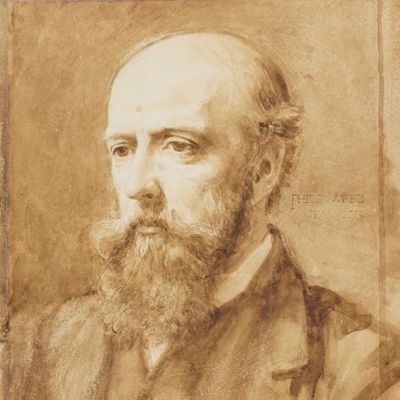
Portrait of Philip Webb by Charles Fairfax Murray, National Portrait Gallery.

A rare trestle table c.1865
Designed by Philip Webb
Made by the occupants of the 'Home for Destitute Boys' Euston Road, London.
Retailed by Morris & Company

A rare trestle table c.1865
Designed by Philip Webb
Made by the occupants of the 'Home for Destitute Boys' Euston Road, London.
Retailed by Morris & Company

A rare trestle table c.1865
Designed by Philip Webb
Made by the occupants of the 'Home for Destitute Boys' Euston Road, London.
Retailed by Morris & Company

A claret glass, after 1862
Designed by Philip Webb
Made by James Powell & Son.

A wine glass, after 1862
Designed by Philip Webb
Made by James Powell & Son.

A cordial glass, after 1862
Designed by Philip Webb
Made by James Powell & Son.