Signed in as:
filler@godaddy.com
The gothic revival is a renewal of interest in the European style of architecture from the 13th and 14th centuries. The catalyst for the revival started when, in the second half of the 18th century, Horace Walpole designed his home Strawberry Hill on the bank of the Thames in the Georgian ‘Gothick’ style, as it was called at the time. The unusual building was of great interest and so Walpole sold tickets to the public to come in a immerse themselves in a fascinating new style.
See Horace Walpoles Strawberry Hill House drawn by G Bernard engraved by Frederick Smith published by W B Cooke in 1831.

This was followed closely by William Beckford when he employed the architect James Wyatt to build Fonthill Abbey in Wiltshire in the late 1790’s. By 1822 Beckford grew tired of living in the Abbey and arranged to offer it for sale, whereby Christies auctioneers sold thousands of tickets to the public to view the house and its contents. Moments before the auction Beckford sold the Abbey privately behind the auctioneer’s back, this buyer then approached Phillips auctioneers to sell the surplus contents in 1823, again thousands of tickets were sold to the public.
See William Beckford's Fonthill Abbey drawn by R Martin engraved by Thomas Higham published by John Rutter in 1823.

Gothic Revival was fast becoming the new style to have; so much so, when a competition was held in 1835 to find a design to replace the recently burned-down Palace of Westminster in London (the centre of power for the British Empire) the style chosen was Gothic Revival. Whilst the architect who won the commission was Charles Barry, he subcontracted the vast majority of the design-work to the 23-year-old Augustus Welby Northmore Pugin. Pugin designed the wallpaper, door handles, stationary stands, light fittings, floor tiles, carpets, furniture, interior and exterior masonry, fireplaces and wood panelling. It was this level of detail, on this and many other commissions that ultimately lead to Pugin death in 1852 aged just 40. Owing to this vast output, Pugin is regarded as the father of the Gothic Revival. However, Pugin was not alone, at this time other architects were experimenting with gothic too, Anthony Salvin, George Gilbert Scott to name just two.
See a stool designed by A.W.N. Pugin c.1840.
Sold by us to a private collection.

From 1839 the Cambridge Camden Society (later the Ecclesiological Society from 1845) was a highly influential Victorian group of Cambridge academics that championed the Gothic Revival; this society is the reason the majority of Victorian Churches were built in the Gothic Revival style and it was there that once again the public were exposed to the Gothic. Both William Butterfield and George Edmund Street contributed designs to the Society’s publications.
In France, 1844 was the year a 37-year-old Eugène Emmanuel Viollet-le-Duc and his friend the architect Jean-Baptiste Lassus, won a competition for the restoration of Notre-Dame Cathedral in Paris, a commission that lasted twenty-five years. Throughout his career Viollet-le-Duc published highly influential and lavishly illustrated books, famously William Burges referred to them stating that “we all crib from Viollet-le-Duc”.
Between 1851-1853 the art critic John Ruskin published his three-volume treatise on the art and architecture in the Byzantine, Gothic and Renaissance periods of Venice’s architecture, called ‘The Stones of Venice’. In the chapter ‘The Nature of Gothic’ Ruskin writes how key the workman was and emphasises the importance of rejecting mechanisation and thus reinforcing the styles appeal to younger minds.
See plate VIII from John Ruskin's The Stones of Venice.

‘The Stones of Venice’ inspired a generation of architects to travel Europe and study gothic architecture ensuring that from the middle of the 19th century the Gothic Revival firmly took hold; the baton was handed from Pugin to architects such as George Edmund Street, Alfred Waterhouse, William Butterfield, John Pollard Seddon and George Gilbert Scott.
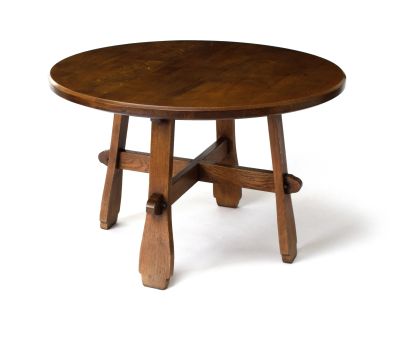
Chief among them was a former employee of Scott, George Edmund Street; in his role as Oxford’s dioecian architect, his first major solo commission was Cuddesdon College in Oxfordshire, completed in 1853. Street went on to become one of leading architects of the revival, working mainly on ecclesiastical buildings but also rectories and other domestic buildings before he completed his portfolio with The New Royal Courts of Justice on the Strand in London, even though this vast commission was completed a year following his death in 1881.
See a table designed by George Edmund Street for Cuddesdon College in 1853.
Sold by us to a private collection.
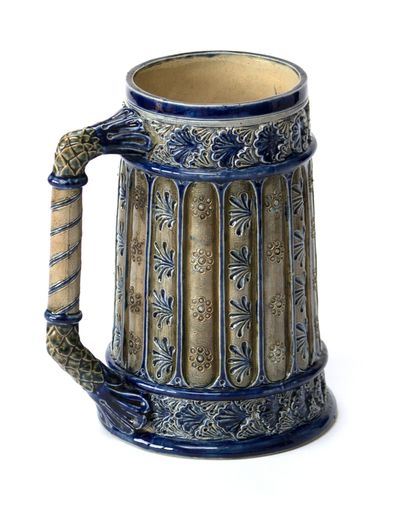
The Medieval Court at the 1862 London International Exhibition again exposed the public to the style. Organised by the Ecclesiastical Society the court, an area within the international exhibition, showcased a wide variety of work, including textiles, furniture, masonry, sculpture and ceramics by all the leading architects of the period. It was there that the furniture designed by the eccentric architect William Burges was first shown; his medieval-revival furniture was painted and decorated by fledgling group calling themselves the Pre-Raphaelites. Street showed embroidered altar-fronts made by Jones & Willis, John Pollard Seddon showed furniture and a church organ front made by his family firm and Philip Webb showed furniture made for the newly founded Morris, Marshal Faulkner & Co. The Society stated that the Medieval Court was intended to illustrate that whilst the style has its origins in the medieval, it has a lot to offer modern living.
See a tankard designed by John Pollard Seddon and made by C. J. C. Bailey's Fulham pottery.
Sold by us to the National Museum of Wales.
The stand of the church furnishing company Cox & Company broke away from the roots of the revival by showing work made harnessing mechanised steam-power. This key moment was to dictate the following stage of the Gothic revival; commerce.
Commercial designers made gothic furnishings available to the public. Bruce Talbert was perhaps the most prolific of them. Talbert’s geometric gothic designs were first seen at the 1867 Paris International Exhibition when he exhibited the Pericles cabinet as a centre-piece for the manufacturer’s Holland & Son’s stand. Also, in 1867 he published his most famous book of designs entitled ‘Gothic Forms’. Dedicated to George Edmund Street the book showcased plentiful illustrations of furniture and interiors, further influencing future designers.
The Gothic Revival was chronicled by Charles Locke Eastlake when he published in 1872 his influential ‘History of the Gothic Revival’.
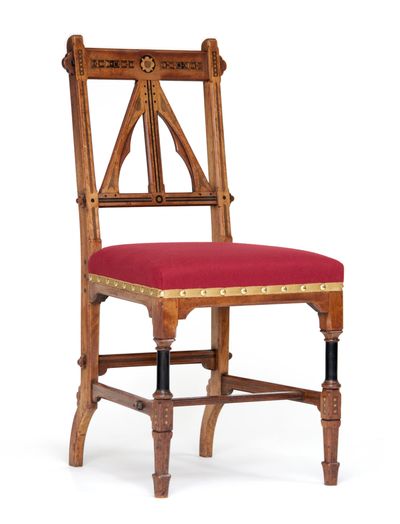
Charles Bevan was a significant designer of this period with his groundbreaking commission to furnish Titus Salt Jnr's Milner Fields house in 1865. For this commission he used the maker Marsh Jones and Cribb of Leeds.
See a chair designed by Charles Bevan for Titus Salt Jnr's Milner Field in 1865.
Sold by us to a private collection.
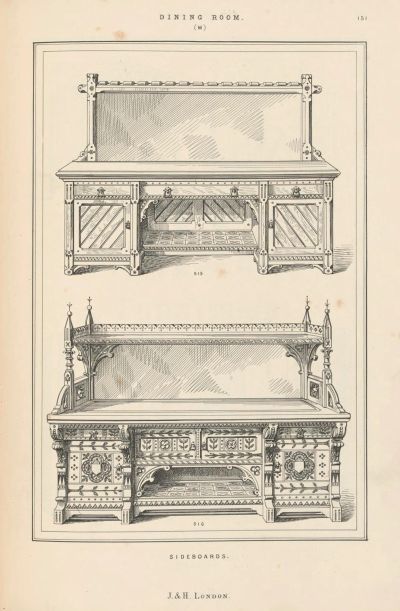
Eventually by the late 1870’s and following huge demand from the middle classes this new geometric Gothic Revival style was diluted and offered at a lower cost by designers such as Richard Charles or James Lovegrove-Holt.
In fact, the majority of furniture attributed to Charles Bevan today was actually designed by the talented, yet sadly forgotten James Lovegrove-Holt.
This marked the beginning of the decline of the Gothic Revival.
See page 151 of James Lovegrove-Holt's catalogue 'Modern Furniture - Plain & Decorative - Original & Select', 1875.
The main protagonists of the Art Nouveau cite Viollet-le-Duc as their inspiration. The two founding figures of the arts a crafts movement, Philip Webb and William Morris, worked and trained under George Edmund Street, the Aesthetic movement pioneer and leading architect of the Queen Anne Revival Richard Norman Shaw also worked under Street, accordingly and in turn their followers and pupils forged their own paths and went on to shape the world in which we live today.
See a candlestick designed by Viollet-le-Duc in 1876.
Sold by us to a private collection.
